.png?width=2497&height=578&name=Baicells_logo_rgb_%E7%99%BD(%E9%80%8F%E6%98%8E).png "Baicells_logo_rgb_白(透明)")
DAS vs. CBRS
Battle of the indoor commercial wireless acronyms
Indoor internet connectivity is an absolute must in today’s connected landscape. Dead zones and dropped connections are reflective of outdated systems and hardware. When commercial buildings suffer from poor internet connectivity, it can result in a lower valuation and potential loss of income. However, today there are more options for improving your indoor network. Spectrum options have increased, and technology is tackling more effective ways to solve existing problems.
This blog compares the differences between using a private Long-Term Evolution (LTE) network via Citizens Broadband Radio Service (CBRS) and a more traditional Distributed Antenna System (DAS) approach to solving indoor connectivity needs to help you better understand which technology is best for your deployment scenario.
Here’s a breakdown of the differences between DAS and CBRS systems for indoor deployments:
· Deployment cost: CBRS systems can be more cost-effective due to the use of shared spectrum, while DAS systems may require a significant upfront investment in
equipment, installation, and licensing.
· Capacity: CBRS systems can provide a lower capacity level, but can be scaled up by adding more devices to the system. CBRS may be more flexible and cost-effective
compared to coordinating multiple antennas and controllers in a DAS system.
· Interference: CBRS systems may be prone to interference due to the shared nature of the spectrum, while DAS systems may be less prone to interference due to the use of
licensed spectrum.
· Network management: CBRS systems may be simpler to manage due to using a single shared spectrum band, while DAS systems may require more complex network
management.
· Flexibility: CBRS systems may be more flexible in adding or removing devices, while DAS systems may be more challenging to modify or expand once deployed.
· Coverage: While DAS systems can provide coverage over a large area, CBRS systems may be sufficient for smaller coverage areas, such as a single floor or wing of a
building. CBRS systems may offer cost savings and a more straightforward deployment process.
A Quick Overview of DAS
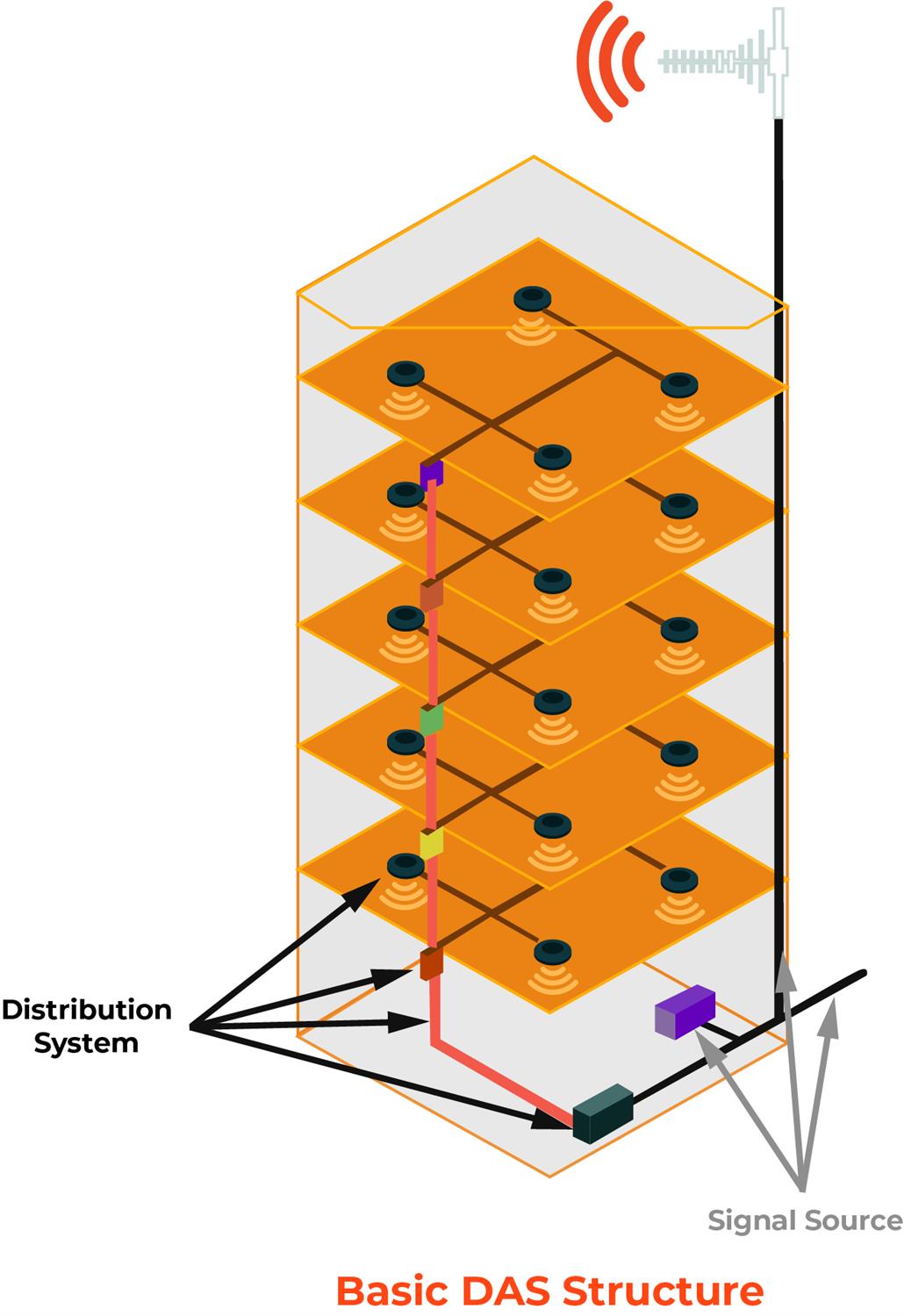
Network operators often turn to DAS to improve indoor internet connectivity for commercial buildings. There are several variants of DAS networks, but (generally speaking), a DAS network receives an internet connection from a public network captured by a primary antenna. The internet signal is then distributed through the building using a system of interconnected antennas. This type of DAS network is called an “Off-Air” system. Off-Air systems can provide additional coverage, but cannot increase network capacity as they are at the mercy of the strength of the connection to the public carrier.
Network operators often need to turn to a Base Transceiver Station (BTS) DAS network for larger deployments, like those in stadiums or airports. This type of network directly incorporates the hardware elements of a traditional cellular network into the building. BTS deployments are costly, requiring proprietary hardware elements and dedicated fiber backhauls that carriers must install.
How CBRS is Shaking Up Indoor Networks
The United States government introduced CBRS to provide an easily accessible, licensed spectrum for network operators. With the introduction of CBRS, Band 48 spectrum started to see increased adoption across various use cases, including healthcare, education, smart cities, smart agriculture, decentralized networks, and indoor enterprise deployments.
CBRS spectrum allows operators to build indoor, private LTE networks that strike the perfect middle ground for networks requiring increased capacity and throughput without prohibitive costs.
By using a distributed small-cell approach, similar to a DAS setup, a network operator can build an indoor private LTE network with increased coverage and capacity reaching deep within any sized building. The approach saves money because you don't need as many network components compared to a BTS DAS buildout, and still allows for full indoor coverage with improved capacity compared to an off-air DAS network. Unfortunately, CBRS is still a shared spectrum, so interference may occur. Still, there’s a good chance that the Spectrum Access System (SAS), which controls the spectrum, will minimize any interference occurrences.
CBRS is Another Tool on your Belt
Ultimately, CBRS is another option for indoor deployments that may work in your favor. Important considerations when deciding between DAS and a private LTE deployment are overall cost, flexibility, and size when comparing these two systems.
DAS can be a great fit for large venues that requires capacity in the tens of thousands. It allows the public to stay connected to their cell phone provider’s network and provides a seamless experience for the end-user. However, the cost of building this network can be prohibitive and time-consuming. Lastly, once the network is built, it can be difficult to adapt or expand to meet growing demand.
Private LTE systems using CBRS are often better for medium to small deployments. CBRS networks are less expensive to deploy and can be customized to meet the needs of the indoor environment to ensure that the building is completely covered with a usable wireless signal. The greater flexibility and ease of management make this solution well-suited for smaller teams, but these networks have a greater chance of interference and do not run off existing public networks.
Ultimately, the choice comes down to the network operator. Private LTE networks can’t replace DAS networks across many larger environments, but for smaller deployment scenarios, CBRS often wins out on cost, flexibility, deployment speed, and ongoing network management.